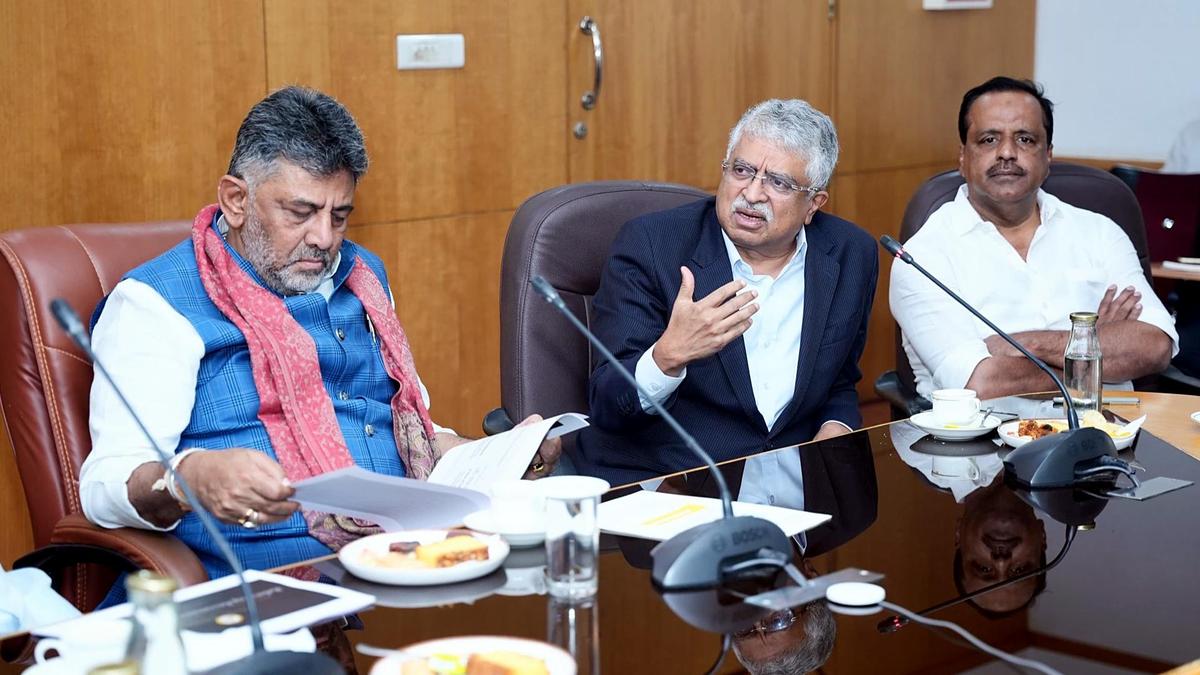
The high-powered task force on examination reforms, constituted by the Centre and chaired by Nandan Nilekani, met Chief Minister D.K. Shivakumar, his Cabinet colleagues, Karnataka Examinations Authority (KEA) officials and other stakeholders in Bengaluru on Saturday to seek their views on factoring board exam marks into the National Eligibility cum Entrance Test (NEET). According to an official at the meeting, State representatives backed considering board exam marks, and the chairman asked for Karnataka's opinion in writing. The panel, set up after the then Union Minister of Education Dharmendra Pradhan tendered his resignation following widespread student protests over the NEET-UG 2026 paper leak, is expected to submit its final report to the Centre in December.
Speaking after the meeting, Mr. Shivakumar said candidates from Karnataka should get greater opportunities for admission to the State's medical colleges. Arguing that rural students find it difficult to compete with urban counterparts in national-level examinations like NEET, he called for grace marks for rural students and reservations for local students in medical seats. Mr. Nilekani told the Chief Minister that other States had agreed to a phased introduction of Computer-Based Test (CBT) for NEET to prevent paper leakage, while noting that most States backed computerisation of recruitment examinations and that care must be taken to ensure the system does not inconvenience candidates from rural or economically disadvantaged backgrounds.
KEA Executive Director H. Prasanna made a presentation on how the national shared infrastructure network could be used. According to sources, the KEA suggested a national survey by AICTE on functional and non-functional computers, connectivity, backup and technical manpower for implementing CBT for all government recruitment exams and NEET, and proposed a State- and district-wise database of institutions and their verified simultaneous examination capacity. Mr. Prasanna said steps were being taken to leverage technical support from the e-Governance Department and curb fraudulent candidates, stressing that organisations like the KEA and KPSC need their own dedicated, skilled technical staff.
S.V. Ranganath, Chairman of the State Competitive Examinations and Recruitment Reform Committee, said setting up the infrastructure, including computer systems, for CBTs would involve significant expenditure, and suggested dedicated computer-based examination centres whose cost could be covered in phases through Centrally-sponsored schemes and State grants, with both governments sharing the burden. Minister for Home and IT&BT Priyank Kharge said the government was at the forefront of establishing a transparent examination system, and that a fact-check mechanism was being implemented to dispel rumours about question paper leakage, with the public advised not to heed rumours until official information is released.